Colostrum on an Empty Stomach or With Food: Which Is Better?
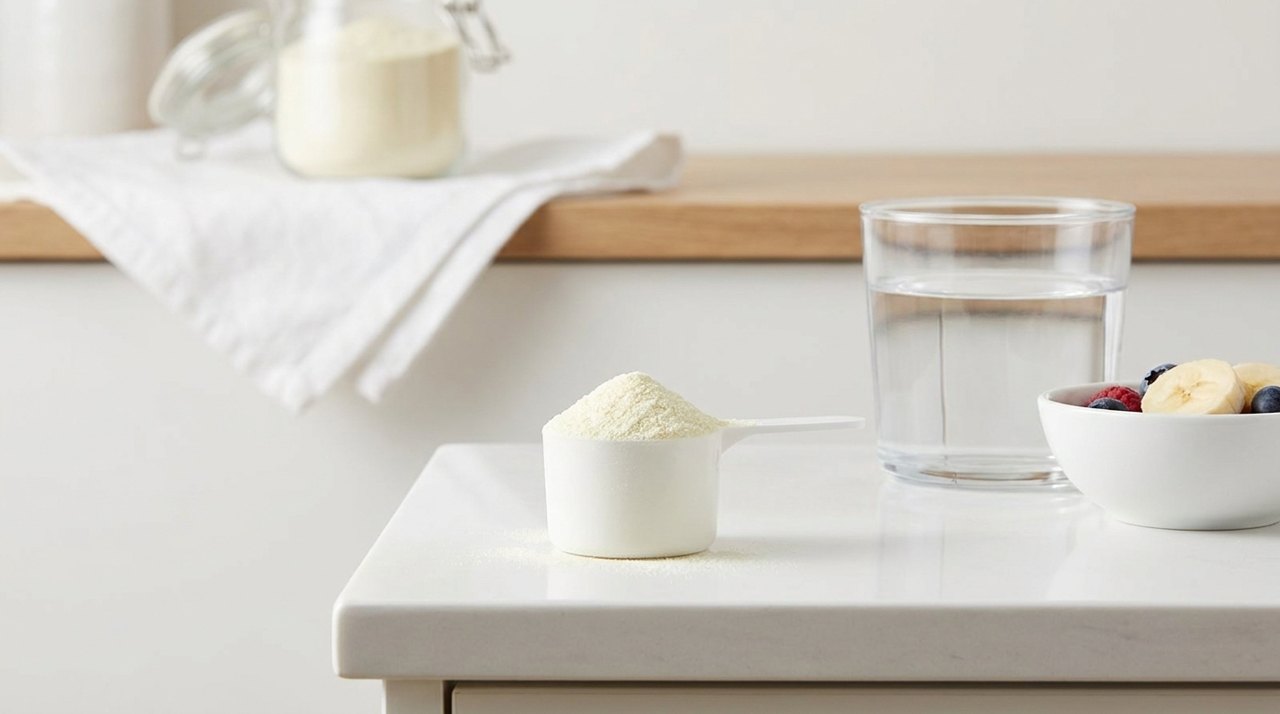
One of the most common questions about colostrum powder is when to take it: first thing in the morning on an empty stomach, or alongside a meal? The honest answer is that the research doesn't settle this cleanly. There are plausible mechanistic arguments for fasted dosing, practical arguments for taking it with food, and very few human trials designed to compare the two head to head. Here's what the reasoning actually rests on, and how to choose based on your own goals and tolerance.
Why timing is even a question
Bovine colostrum powder is a whole-food-style supplement containing immunoglobulins (mainly IgG), lactoferrin, growth factors such as IGF-1, oligosaccharides, and milk proteins. Several of these are proteins — and proteins are, by design, what your digestive system breaks down.
The fasted-stomach argument goes like this: stomach acid and the enzyme pepsin degrade proteins, and a meal triggers a stronger acid and enzyme response. Taking colostrum without food, in theory, means a shorter exposure to that environment and faster transit into the small intestine, where its bioactive components are thought to act on the gut lining. It's a reasonable hypothesis. It is not, however, something that has been demonstrated to produce better outcomes in controlled human comparisons.
The counterargument is that colostrum's components appear to be more resistant to digestion than typical dietary protein — immunoglobulins in particular are structured to survive a newborn's gut — and that a meal buffers stomach acid, which could actually be protective. Both stories are internally consistent. That's usually a sign the evidence is thin.
What the evidence does and doesn't show
Studies on bovine colostrum in humans have looked at gut permeability, exercise-related outcomes, and immune markers. Most used a fixed protocol — a set dose, often twice daily, sometimes specified as before meals — without a comparison arm testing the opposite timing. So when a study reports a result, it tells you that that protocol showed an effect, not that the timing was responsible for it.
- No direct comparative trials. We are not aware of well-powered human studies randomising participants to fasted versus fed colostrum and measuring the same endpoints.
- Survival data is indirect. Some laboratory and animal work suggests a meaningful fraction of colostral IgG survives gastric digestion, but extrapolating exact percentages to your breakfast is speculative.
- Effect sizes are modest anyway. Where benefits have been reported, they tend to be small to moderate. A timing tweak is unlikely to be the difference between working and not working.
In short: timing is a second-order variable. Product quality, consistent dosing, and how long you take it for almost certainly matter more. If you haven't yet settled those, our how to use colostrum powder guide is a better place to start than this one.
Shopping for colostrum? Our current best-value pick is BIOMIXA grass-fed colostrum powder on Amazon.
The practical case for each approach
| Approach | Possible advantages | Trade-offs |
|---|---|---|
| Empty stomach (15–30 min before food) | Theoretically less enzymatic exposure; simple habit anchor; matches most study protocols | More likely to cause nausea, bloating or loose stools in sensitive people |
| With or just after food | Usually gentler on the stomach; easy to blend into a smoothie or oats; better adherence for many | Theoretical dilution and slower gastric emptying; dairy-heavy meals may compound lactose load |
A reasonable default
If you want a starting point rather than a debate, this is a defensible one:
- Begin with a small dose on an empty stomach — for example, half your intended serving, mixed into cool or room-temperature water, 20–30 minutes before breakfast.
- Hold it for a week and note digestion, comfort and any changes you care about.
- If you tolerate it well, build to your full intended dose while keeping the fasted timing.
- If you get any GI discomfort, move the dose to just after a light meal, or split it into two smaller servings. Comfort wins — a dose you take consistently for eight weeks beats a theoretically optimal one you abandon after five days.
Avoid mixing colostrum into hot liquids. High heat can denature proteins, and while the exact temperature threshold in a home kitchen isn't well characterised, there's no upside to testing it. Cool liquids, cold smoothies and unheated yoghurt are safer vehicles — see our colostrum powder recipes for combinations that don't involve heat.
Things that interact with your choice
Lactose sensitivity
Colostrum powder contains some lactose. If you're sensitive, taking it on a completely empty stomach may amplify symptoms, and food may help. Lower-lactose or colostrum-derived isolate products are an alternative worth looking at.
Training around workouts
Some athletes take colostrum pre- or post-exercise. Pre-workout fasted dosing is common in practice, but there's no strong evidence it outperforms simply taking a consistent daily dose at whatever time you'll actually remember.
Medications and other supplements
If you take medication that requires an empty stomach — certain thyroid hormones and some antibiotics, for instance — don't crowd it with a dairy-derived powder. Space them by a couple of hours, and check with your pharmacist or clinician, who can advise on your specific regimen.
Twice-daily splitting
Many study protocols use two smaller doses rather than one large one. If you're taking a higher total amount, splitting it — morning fasted and evening before bed — is a sensible pattern and often better tolerated than a single large serving.
The bottom line
Fasted dosing has a slightly more compelling mechanistic story and matches how most research protocols were run, so it's a fine default if your stomach agrees. But the evidence supporting it over fed dosing is theoretical rather than demonstrated, and there is no basis for treating one as effective and the other as wasted. Colostrum powder is a dietary supplement, not a treatment for any condition, and no timing schedule changes that. Pick the option you'll stick with, keep it consistent, give it a realistic trial period of at least six to eight weeks, and discuss it with a healthcare professional if you're pregnant, immunocompromised, or managing a medical condition.
BIOMIXA Bluegrass Colostrum
A grass-fed, unflavored colostrum powder that balances quality and price well — our pick for the best bang for your buck. Check the current price and reviews on Amazon.